|
|
NewtonsSecondLaw |
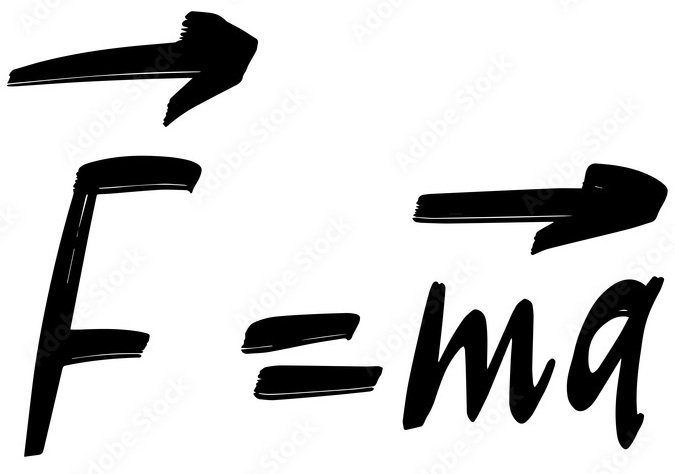
An object's acceleration is equal to the net force acting on the object divided by the object's mass; $\mathbf{F}_\mathrm{net}=m \mathbf{a}$. |
0 |
Ready |
Edit
|
|
|
Normal |
The normal to a surface is a line perpendicular to the surface. |
0 |
Ready |
Edit
|
|
|
NormalForce |
Each of two objects in contact exerts a force on the other. This force is perpendicular to the contact surface and is called the normal force. |
0 |
Ready |
Edit
|
|
|
ObjectCharge |
The electric charge $q_A$ on a macroscopic object $A$ is equal to its number of protons minus its number of electrons, times the elementary charge unit $e$. |
0 |
Ready |
Edit
|
|
|
ObjectColor |
The color of an object is the color that it reflects into your eye. |
2 |
Ready |
Edit
|
|
|
ObjectDistance |
The object distance $d_\text{o}$ is the distance from the object to the center of the optical element. |
0 |
Ready |
Edit
|
|
|
Opaque |
Opaque materials transmit very little light. |
1 |
Ready |
Edit
|
|
|
Pinhole |
A pinhole is an opaque material with a small hole. The material blocks most light rays and the hole transmits a few light rays. |
0 |
Ready |
Edit
|
|
|
PinholeImage |
A pinhole makes an inverted real image at every distance beyond the pinhole. |
0 |
Ready |
Edit
|
|
|
PinholeNearFarImage |
Images near the pinhole are small and bright. Images far from the pinhole are large and dim. |
0 |
Ready |
Edit
|
|
|
PinholeSmallLargeImage |
An image formed by a small pinhole is sharp and dim. An image formed by a large pinhole is fuzzy and bright. |
0 |
Ready |
Edit
|
|
|
PlaneMirror |
A plane mirror is a flat mirror. |
0 |
Ready |
Edit
|
|
|
PlaneMirrorImage |
A plane mirror makes an upright virtual image the same distance behind the mirror as the object is in front of the mirror. |
0 |
Ready |
Edit
|
|
|
PointApprox |
An object can be assumed to be a point particle when its dimensions are very small relative to its distance from other objects. |
0 |
Ready |
Edit
|
|
|
Position |
A position is a point in space. |
0 |
Ready |
Edit
|
|
|
PositionTable |
A position table shows the position of an object along a path at equal successive times (clock readings). |
1 |
Ready |
Edit
|
|
|
PosSlopeIsVel |
For motion in one dimension, the slope of the tangent to the graph of position v. time at a particular time (clock reading) is the instantaneous velocity at that time. |
2 |
Ready |
Edit
|
|
|
PosVelIncreasingPos |
The value of the position, on a particular axis, of an object having a positive velocity along that axis during a time interval will be greater at the end of the interval than at the beginning. |
0 |
Ready |
Edit
|
|
|
Precision |
The precision of a set of measurements is the spread of the measurements. |
0 |
Ready |
Edit
|
|
|
Prediction |
A prediction is an assertion (claim) about what might happen under certain conditions concerning a natural phenomenon or the results of a planned investigation. |
0 |
Ready |
Edit
|
|
|
PrincipalRaysName |
The principal rays are the parallel ray, the central ray, the focal ray, and for a spherical mirror, the center of curvature ray. |
0 |
Ready |
Edit
|
|
|
PrincipalRaysUses |
Any two principal rays determine the image. |
2 |
Ready |
Edit
|
|
|
PrismsRaindrops |
Prisms and raindrops separate light into colors. |
0 |
Ready |
Edit
|
|
|
ProjectileMotion |
Projectile motion is motion under the influence of only Earth's gravitational acceleration $g$, which is assumed constant in magnitude and direction. This means that the motion must be near Earth's surface, over distances that are small relative to Earth's radius, and air resistance and other forces are assumed to be negligible. |
5 |
Ready |
Edit
|
|
|
ProtonCharge |
The proton charge is $e$, the elementary charge. |
0 |
Ready |
Edit
|
|
|
ProtonMass |
The proton mass, $m_\mathrm{p}$, is $1.67 \times 10^{-27} \, \mathrm{kg}$. |
0 |
Ready |
Edit
|
|
|
RealImage |
A real image is an image that is formed by light rays and can be viewed on a screen. |
0 |
Ready |
Edit
|
|
|
Reflection |
Reflection is when light bounces off an object. |
0 |
Ready |
Edit
|
|
|
Refraction |
Refraction is when light changes direction as it enters a different medium. |
0 |
Ready |
Edit
|
|
|
RefractionDirection |
Light bends toward(away from) the normal to the interface between the two media when it enters a medium in which light travels slower(faster). |
0 |
Ready |
Edit
|
|
|
RopeForceDirection |
The direction of the force exerted by a rope on an object is along the rope and away from the object. |
0 |
Ready |
Edit
|
|
|
RoughReflection |
Objects that are not mirrors reflect light in all directions. |
0 |
Ready |
Edit
|
|
|
RubbingCharge |
A few electrons can be transferred from some macroscopic objects to others by rubbing the objects together. |
0 |
Ready |
Edit
|
|
|
SameForceMoreMassLessAccel |
When equal net forces act on objects having different masses, the acceleration of the more massive object will be less than the acceleration of the less massive object. |
0 |
Ready |
Edit
|
|
|
SameMassMoreForceMoreAccel |
When objects having the same mass are acted upon by net forces of different strengths, the object acted upon by the greater force will experience a greater acceleration. |
0 |
Ready |
Edit
|
|
|
ScientificExplanation |
A scientific explanation includes an assertion (claim) about natural systems or designed objects, systems, or phenomena; the evidence, which consists of empirical evidence or observations, related to the claim; and reasoning that links the claim with the evidence. |
0 |
Ready |
Edit
|
|
|
ScientificQuestion |
A scientific question is a question that leads to an empirical investigation (collecting and interpreting data to develop an explanation). |
0 |
Ready |
Edit
|
|
|
Second |
The second is the duration of $9\,192\,631\,770$ periods of the radiation corresponding to the transition between the two hyperfine levels of the ground state of the cesium-133 atom. |
0 |
Ready |
Edit
|
|
|
SeeLightSource |
Light sources are seen when a light ray travels directly from the light source to an observer's eye. |
0 |
Ready |
Edit
|
|
|
SeeObject |
Objects that are not light sources are seen when light travels from a light source, bounces off the object, and enters the observer's eye. |
1 |
Ready |
Edit
|
|
|
Shadow |
A shadow is formed when an object blocks (absorbs or reflects) the light that hits it, but other light goes straight past the edges of the object. |
0 |
Ready |
Edit
|
|
|
ShadowOppositeSource |
The shadow is on the opposite side of the object from the light source. |
0 |
Ready |
Edit
|
|
|
SIBaseUnits |
The seven SI base units are the meter, kilogram, second, ampere, kelvin, mole, and candela. |
0 |
Ready |
Edit
|
|
|
SidewaysForceDirChange |
A force acting on an object, in a direction to the left(right) of the object's motion, will cause a leftward(rightward) change in the direction of the object's motion. |
0 |
Ready |
Edit
|
|
|
SingleForceStart |
If a (single) force acts on a stopped object, the object will start to move, and the motion will be in the direction of the force. |
0 |
Ready |
Edit
|
|
|
SingleForceVelOppDir |
A (single) force acting on an object, in the direction opposite to the object's velocity, decreases the object's speed. |
0 |
Ready |
Edit
|
|
|
SingleForceVelPerpendicular |
A (single) force acting on an object, in a direction perpendicular to the object's velocity, changes the object's direction but not its speed. |
0 |
Ready |
Edit
|
|
|
SingleForceVelSameDir |
A (single) force acting on an object, in the same direction as the object's velocity, increases the object's speed. |
0 |
Ready |
Edit
|
|
|
SnellsLaw |
When a light ray in a medium having index of refraction $n_1$ enters a medium having index of refraction $n_2$ at an angle of incidence $\theta_1$, the angle of refraction $\theta_2$ is given by Snell's Law, $n_1 \sin\theta_1 = n_2 \sin \theta_2$. |
1 |
Ready |
Edit
|
|
|
SpecularReflection |
Specular reflection is reflection that follows the law of reflection. |
0 |
Ready |
Edit
|