|
|
Image |
An image is a region of space that contains a point-to-point, systematic, invertible mapping of points in a source. |
0 |
Ready |
Edit
|
|
|
ImageDistance |
The image distance $d_i$ is the distance from the center of the optical element to the image. |
0 |
Ready |
Edit
|
|
|
IndependentVariable |
The independent variable of a controlled experiment is the quantity whose values are changed by the investigator. |
0 |
Ready |
Edit
|
|
|
IndepMotions |
The component of an object's velocity along an axis is not affected by a component of acceleration along a perpendicular axis. |
4 |
Ready |
Edit
|
|
|
IndexOfRefraction |
A material's index of refraction $n$ is the ratio of the speed of light in vacuum $c$ to the speed of light in the material $v$, $n=\frac{c}{v}$. |
0 |
Ready |
Edit
|
|
|
Instant |
An instant is a point in time. |
0 |
Ready |
Edit
|
|
|
InstantaneousChange |
An instantaneous change in a quantity is the limiting value of the change in the quantity's value, divided by the duration of that change, as the duration approaches zero. |
0 |
Ready |
Edit
|
|
|
KEEqnUnits |
The equation for kinetic energy is $\text{KE}=\frac{1}{2} m v^2$, where $\text{KE}$ is the object's kinetic energy, in joules, $m$ is the object's mass, in kilograms, and $v$ is the object's speed, in meters per second. |
0 |
Ready |
Edit
|
|
|
Kilogram |
The kilogram is defined by taking the fixed numerical value of the Planck constant $h$ to be $6.62607015 \times 10^{-34}$ when expressed in the unit $\textrm{J s}$, which is equal to $\textrm{kg} \, \textrm{m}^2 \, \textrm{s}^{–1}$, where the meter and the second are defined in terms of $c$ and $\Delta \nu_{\textrm{Cs}}$. |
0 |
Ready |
Edit
|
|
|
KinEqn1_vat |
One-dimensional motion with constant acceleration is described by the equation $v_2=v_1 + a (t_2-t_1)$, where $v_2$ is the velocity at time $t_2$, $v_1$ is the velocity at time $t_1$, and $a$ is the acceleration. |
2 |
Ready |
Edit
|
|
|
KinEqn2_dvt |
One-dimensional motion with constant acceleration is described by the equation $x_\text{2}=x_\text{1} + \frac{1}{2} (v_\text{1}+v_\text{2}) (t_\text{2}-t_\text{1})$, where $x_\text{2}$ is the position at time $t_\text{2}$, $x_\text{1}$ is the position at time $t_\text{1}$, $v_\text{2}$ is the velocity at time $t_\text{2}$, and $v_\text{1}$ is the velocity at time $t_\text{1}$. |
6 |
Ready |
Edit
|
|
|
KinEqn3_dv_plus_at^2 |
One-dimensional motion with constant acceleration is described by the equation $x_2=x_1 + v_1 (t_2-t_1)+\frac{1}{2} a (t_2-t_1)^2$, where $x_2$ is the position at time $t_2$, $x_1$ is the position at time $t_1$, $v_1$ is the velocity at time $t_1$, and $a$ is the acceleration. |
8 |
Ready |
Edit
|
|
|
KinEqn4_2adv^2 |
One-dimensional motion with constant acceleration is described by the equation $v_2^2=v_1^2 + 2 a (x_2-x_1)$, where $v_2$ is the velocity at time $t_2$, $v_1$ is the velocity at time $t_1$, $a$ is the acceleration, $x_2$ is the position at time $t_2$, and $x_1$ is the position at time $t_1$. |
2 |
Ready |
Edit
|
|
|
KinEqn5_dv_minus_at^2 |
One-dimensional motion with constant acceleration is described by the equation $x_2=x_1 + v_2 (t_2-t_1)-\frac{1}{2} a (t_2-t_1)^2$, where $x_2$ is the position at time $t_2$, $x_1$ is the position at time $t_1$, $v_2$ is the velocity at time $t_2$, and $a$ is the acceleration. |
2 |
Ready |
Edit
|
|
|
KineticEnergy |
Kinetic energy is the energy that an object has because it is in motion. |
0 |
Ready |
Edit
|
|
|
KineticFriction |
Kinetic friction is the force exerted by one surface on another surface, because they are sliding along each other, that is parallel to the surfaces' interface. |
0 |
Ready |
Edit
|
|
|
KineticFrictionDirection |
The force of kinetic friction opposes the relative motion of the two surfaces. |
0 |
Ready |
Edit
|
|
|
KineticFrictionStrength |
A useful approximation for the strength of the force of kinetic friction is $F_\mathrm{k}=\mu_\mathrm{k} F_\mathrm{N}$ where $F_\mathrm{N}$ is the magnitude of the normal force and $\mu_\mathrm{k}$ is a constant characterizing the interaction of the two surfaces. |
0 |
Ready |
Edit
|
|
|
LawOfReflection |
The angle of incidence equals the angle of reflection. |
0 |
Ready |
Edit
|
|
|
Lens |
A lens is a transparent object that bends light. |
0 |
Ready |
Edit
|
|
|
LensCentralRay |
For a lens, the central ray originates at the object and travels straight through the center of the lens. |
0 |
Ready |
Edit
|
|
|
LightColorReflect |
A light-colored object reflects most of the light that hits it. |
0 |
Ready |
Edit
|
|
|
LightRay |
A light ray is a way to represent light. |
0 |
Ready |
Edit
|
|
|
LightSource |
A light source is an object that produces light, like a candle, light bulb or the sun. |
0 |
Ready |
Edit
|
|
|
LightSpeeds |
Light travels at different speeds in different media. Light travels fastest in a vacuum. |
0 |
Ready |
Edit
|
|
|
LightStraightLine |
Light travels in a straight line. |
0 |
Ready |
Edit
|
|
|
LinearMomentumConserved |
Linear momentum is conserved. |
0 |
Ready |
Edit
|
|
|
LuminousIntensityUnit |
The SI unit for luminous intensity is the candela. The candela is the luminous intensity, in a given direction, of a source that emits monochromatic radiation of frequency $540 \times 10^{12}$ hertz and that has a radiant intensity in that direction of $(1/683)$ watt per steradian. |
0 |
Ready |
Edit
|
|
|
Magnification |
The magnification $M$ of an object produced by an optical system is the ratio of the image height to the object height. |
0 |
Ready |
Edit
|
|
|
MagnificationDistanceEqn |
If the object and image are in the same medium, then the magnification is $M = \frac{-d_i}{d_o}$. |
0 |
Ready |
Edit
|
|
|
MagnificationPosNeg |
A positive(negative) magnification indicates an upright(inverted) image. |
0 |
Ready |
Edit
|
|
|
Magnitude |
Magnitude, or length, is one of the two components of a vector. |
0 |
Ready |
Edit
|
|
|
Mass |
An object's mass is a measure of the amount of matter in the object. The SI unit of mass is the kilogram (kg). |
0 |
Ready |
Edit
|
|
|
MassConserved |
Mass is conserved. |
0 |
Ready |
Edit
|
|
|
Medium |
A medium is a material that light or other form of energy travels in or through. |
0 |
Ready |
Edit
|
|
|
Mirror |
A mirror is an object that reflects light according to the law of reflection, or specular reflection. |
0 |
Ready |
Edit
|
|
|
MirrorCenterOfCurvatureRay |
For a spherical mirror, the center of curvature ray originates at the object, either passes through or is directed toward the center of curvature, and reflects straight back. |
0 |
Ready |
Edit
|
|
|
MirrorCentralRay |
For a mirror, the central ray originates at the object, travels to the center of the mirror and reflects. |
0 |
Ready |
Edit
|
|
|
MirrorReflection |
Reflection from mirrors is specular reflection. |
0 |
Ready |
Edit
|
|
|
MirrorThinLensEquation |
For mirrors and thin lenses, the relationship of the focal length $f$, object distance $d_\text{o}$, and image distance $d_\text{i}$ is $\frac{1}{d_\text{o}} + \frac{1}{d_\text{i}} = \frac{1}{f}$. |
1 |
Ready |
Edit
|
|
|
MoonMass |
The Moon's mass is $7.34 \times 10^{22}$ kg. |
0 |
Ready |
Edit
|
|
|
Motion |
An object's motion is its position at a series of times (clock readings). |
0 |
Ready |
Edit
|
|
|
N2CompEquation |
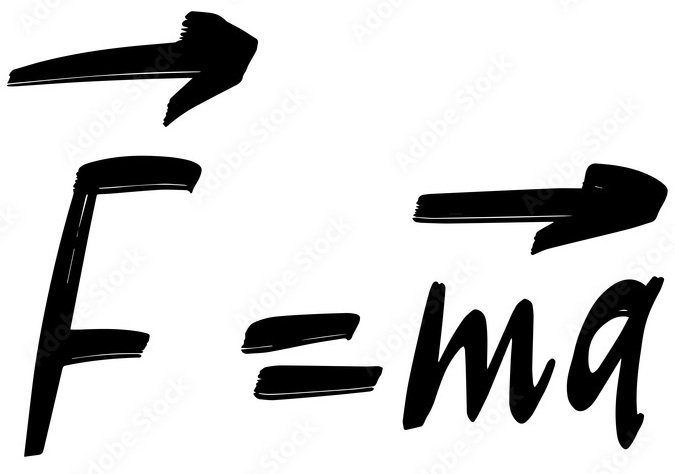
The component of an object's acceleration in a particular direction is equal to the component of the net force in that direction, divided by the object's mass; $a_\text{x}= \frac{F_{\text{net,x}}}{m}$. |
0 |
Ready |
Edit
|
|
|
NegAccelDecreasingVel |
An object having a negative component of acceleration in a particular direction during a time interval will have a lesser component of velocity in that direction at the end of the interval than at the beginning of the interval. |
0 |
Ready |
Edit
|
|
|
NegVelDecreasingPos |
The value of the position, on a particular axis, of an object having a negative velocity along that axis during a time interval will be less at the end of the interval than at the beginning. |
0 |
Ready |
Edit
|
|
|
NetForce |
The net force on an object is the sum of the individual forces acting on the object. |
0 |
Ready |
Edit
|
|
|
NetForce2Collinear |
Given two forces acting on an object along the same line, the net force on the object is (1) if the forces' directions are the same, a single force with magnitude equal to the sum of the forces' magnitudes and in the same direction (2) if the forces' directions are different and their magnitudes are different, a single force with magnitude equal to the difference of the two forces' magnitudes and in the direction of the stronger force (3) if the forces' directions are different and their magnitudes are the same, zero. |
0 |
Ready |
Edit
|
|
|
NeutronCharge |
The neutron is neutral. |
0 |
Ready |
Edit
|
|
|
NeutronMass |
The neutron mass, $m_\mathrm{n}$, is $1.67 \times 10^{-27}$ kg. |
0 |
Ready |
Edit
|
|
|
NewtonsFirstLaw |
If the net force on an object is zero, the object's acceleration is zero, and vice versa. |
0 |
Ready |
Edit
|